
Written by Angelo Soraci, Projects Director, Bluestone Group
As offshore wind, subsea, and energy projects expand worldwide, the vessels supporting them face growing technical and commercial pressure. Operators of offshore support vessels (OSVs), cable layers, and pipe layers are being asked to operate more efficiently without interrupting project schedules. Yet with shipyard capacity stretched thin, finding space or time for traditional drydock retrofits has become increasingly difficult.
Independent analyses from industry bodies highlight a widening gap between retrofit demand and available capacity. Lloyd’s Register data indicates that global repair yards can currently accommodate fewer than 500 retrofit projects per year, while demand is expected to more than double by 2030. Modelling from ABS and Maritime Strategies International suggests that even under moderate growth scenarios, capacity shortfalls will emerge well before the decade’s end, while Drewry forecasts a sharp rise in yard days dedicated to retrofit and repair. Together, these findings point to a structural bottleneck that could hinder compliance for thousands of vessels worldwide.
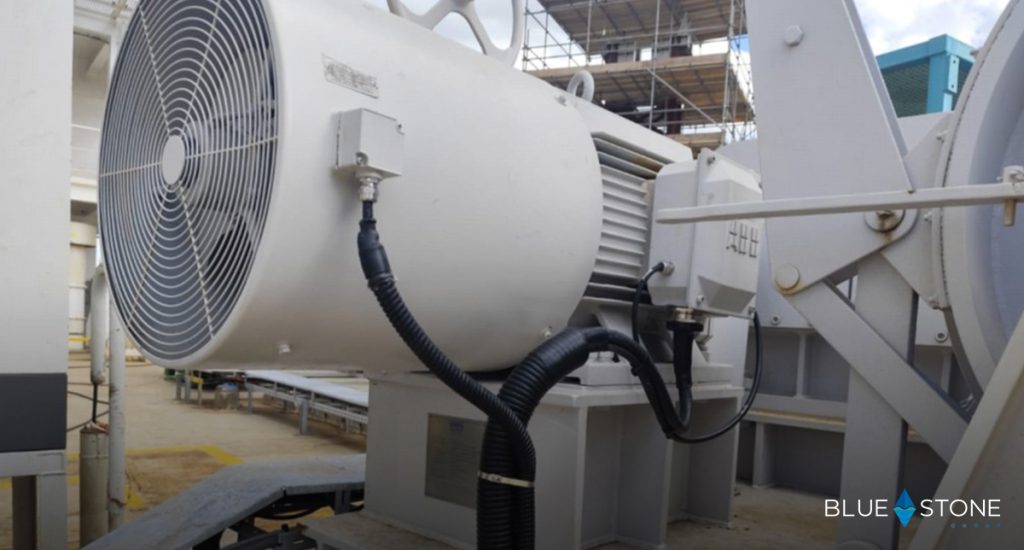
For specialist tonnage, every day off-hire represents more than lost revenue, it can mean missed installation windows, contractual penalties, or delayed project handovers. As a result, operators are rethinking how and where essential upgrades are delivered.
Traditional retrofit models rely on extended yard stays, but shorter drydock cycles and heavier maintenance loads make that approach increasingly unsustainable. To remain competitive, owners need partners capable of executing complex integrations at sea or during short port calls, reducing off-hire without compromising safety or quality.
At Bluestone Group, this approach has become standard practice. Our teams deliver a growing share of retrofit and integration projects on-voyage, focusing on systems that deliver measurable efficiency and compliance benefits, from advanced automation and hybrid-readiness to air- and water-treatment and electrical upgrades. Each project is managed through a structured EPC framework combining naval architecture, marine engineering, and site-management expertise with digital progress tracking. By planning logistics and prefabrication upfront, our engineers anticipate integration challenges early and maintain consistent quality across global regions.
Managing retrofit complexity
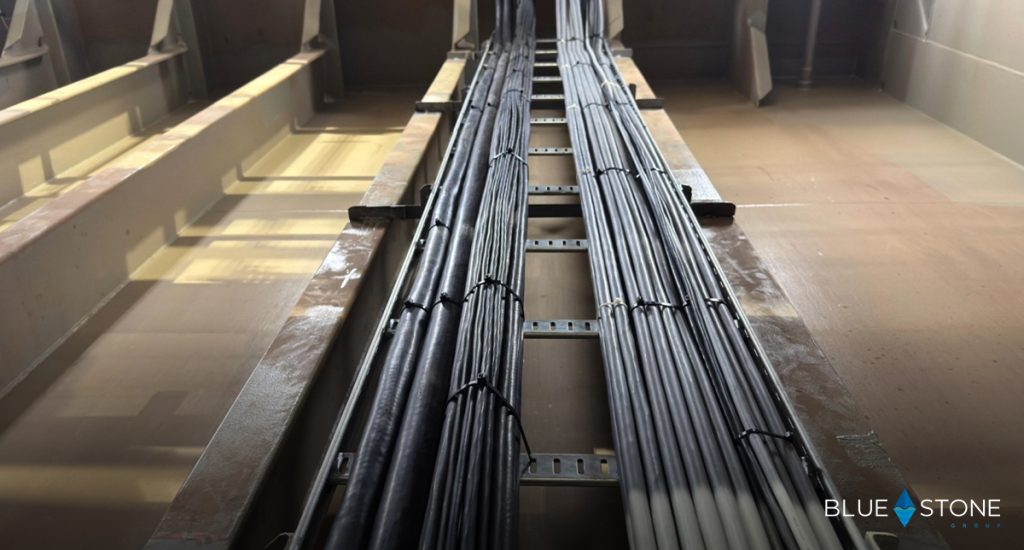
Recent electrical-integration programmes illustrate the scale and precision now achievable on-voyage. On a special purpose vessel, Bluestone installed over 20 km of cabling to retrofit new cranes, winches, loading tools, project containers, and distribution panels. A team of more than 30 specialists worked for nearly three months across multiple locations – beginning at a Mediterranean shipyard, continuing on-voyage while the vessel remained operational, and concluding the commissioning in England. Beyond installation, Bluestone managed engineering and planning from design to delivery, ensuring documentation and quality remained consistent throughout.
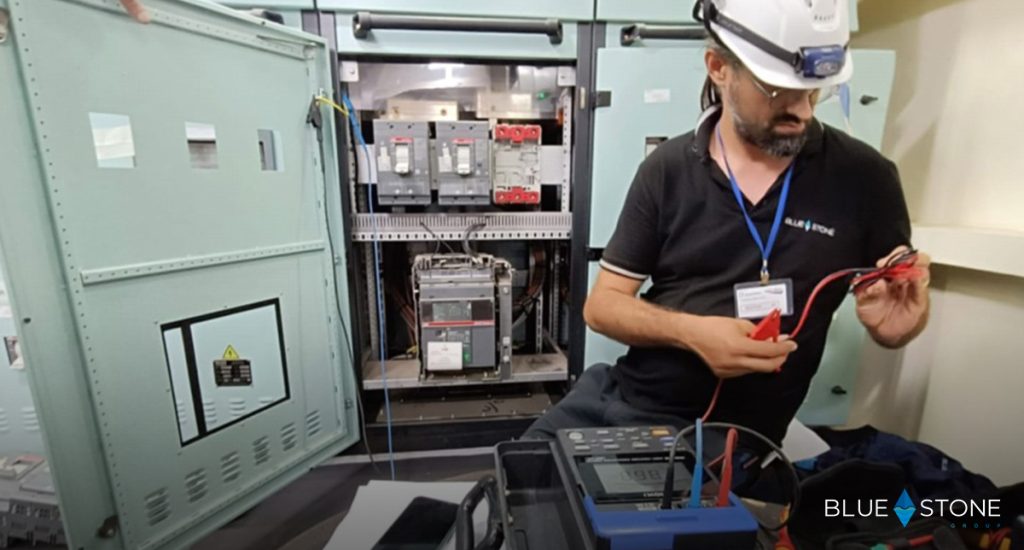
Another project on a pipe-laying vessel involved assembling, installing, and commissioning medium- and low-voltage switchboards, integrating new automation systems, and connecting 11 kV transformers under challenging conditions including confined spaces, work at height, and concurrent maintenance. Despite these constraints (and pandemic travel restrictions) the project was completed safely, on time, and on budget. These examples demonstrate that even technically complex upgrades can be achieved without a full yard stay, provided preparation, engineering, and execution are managed holistically.
The greatest obstacles to scaling these successes lie not in technical feasibility but in logistics and workforce coordination. Regional shortages of skilled labour, longer lead times for components, and fragmented supply chains can undermine even the best-designed projects. Bluestone mitigates these risks through precise construction design, detailed prefabrication, global supply-chain mapping, and trusted partnerships across Europe, Asia, and the Americas. A centralised digital reporting system allows owners to monitor progress in real time, while standardised quality assurance ensures that every project, from minor automation works to full system replacements, meets the same engineering and safety standards worldwide.
A lifecycle mindset
Retrofit planning can no longer be reactive. Stricter environmental regulations and the transition to low-carbon operations have turned retrofitting from an operational preference into a compliance necessity. The most forward-thinking owners are adopting a lifecycle approach – treating each intervention, whether on-voyage, at anchor, or in drydock, as part of a continuous improvement strategy that enhances long-term efficiency and compliance.
This phased mindset spreads both cost and technical risk, allowing upgrades to be sequenced around natural operational pauses. It also supports fleet-wide consistency – a growing priority as operators seek to harmonise standards across geographically dispersed assets. For offshore and subsea vessels, where project windows are tight and weather-dependent, the ability to complete upgrades between assignments offers a clear commercial advantage.
This philosophy underpins Bluestone’s approach: integrating engineering, procurement, and construction expertise under one roof to help owners plan ahead, compressing yard time when unavoidable and eliminating it wherever possible.
As the industry works to meet decarbonisation targets, the retrofit pipeline will only intensify, encompassing fuel-readiness conversions, battery-hybrid integrations, and advanced automation systems. With global yard capacity already saturated, the ability to deliver technically complex upgrades on-voyage or during short port calls will be essential to maintaining compliance and uptime.
The next decade will favour operators who view retrofit execution not as a disruption but as an enabler of resilience. Those who embed lifecycle engineering into fleet strategy will meet regulations faster, preserve operational continuity, and extend asset value. In this context, on-voyage retrofits become a blueprint for sustainable competitiveness in a constrained and fast-moving commercial landscape.